The term “slurry” is commonly used, but…
Have you ever heard the term “slurry”?
If you work in fields such as wastewater treatment, paint, civil engineering, chemical processing, or surface treatment plants, it is likely a familiar term.
“Slurry” is a term commonly used in industrial fields to describe a thick suspension in which solid particles are mixed into a liquid. But what exactly qualifies as a slurry?
A slurry, also referred to as mud slurry, is a state in which solid particles are dispersed within a liquid. Simply put, it is a condition where many very fine solid particles are suspended in a liquid.
Slurries may be used intentionally in industrial production processes, or they may be generated as byproducts in processes such as industrial wastewater treatment.
In the wastewater field, slurry is often confused with similar terms such as scum or sludge. However, these can be clearly distinguished based on the amount of solid content in the liquid and the characteristics of the particles involved.
You Might Be Surprised What’s Considered “Slurry”
Here, we introduce some familiar examples of slurry.
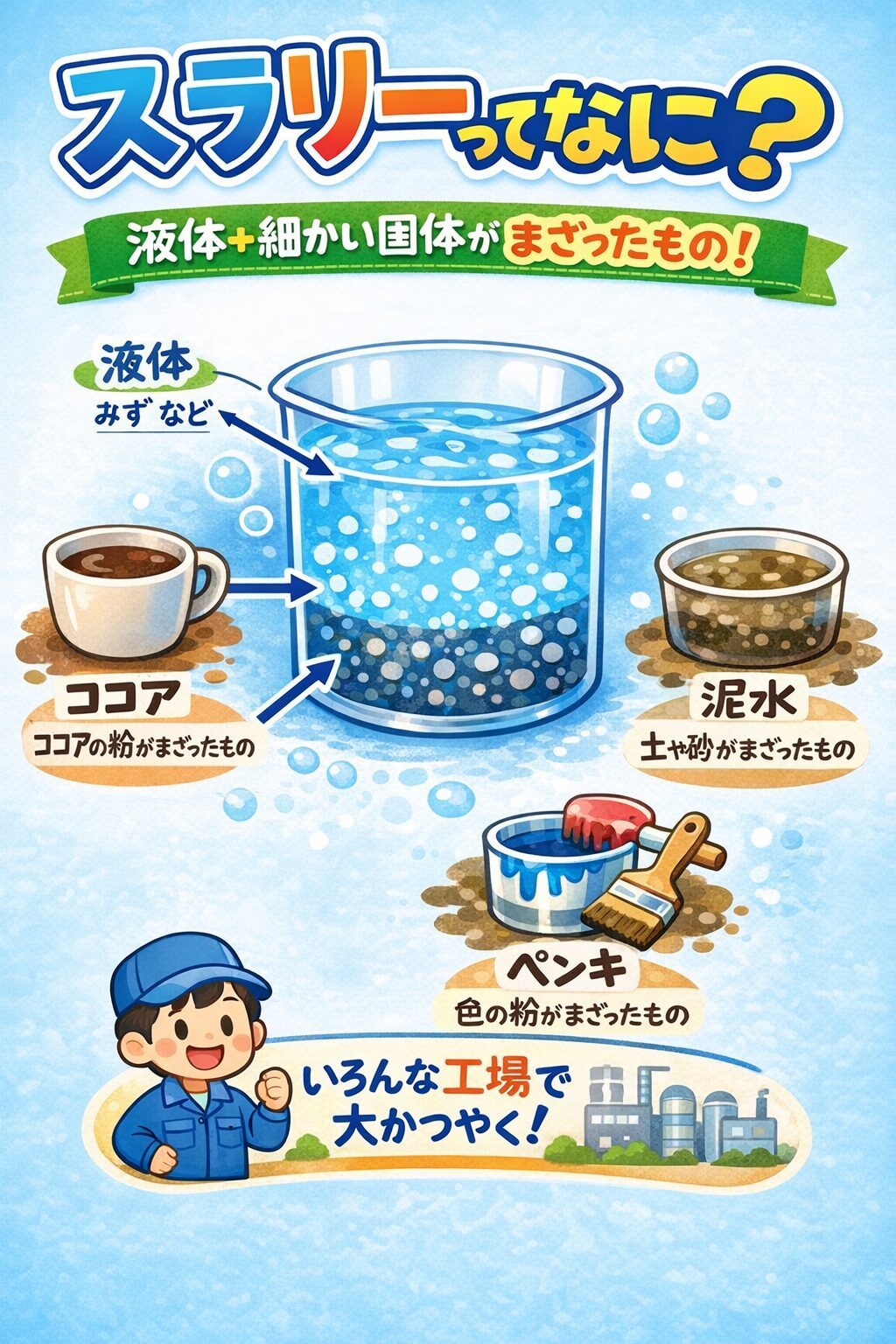
- Cocoa
→ Cocoa powder mixed into hot water - Muddy Water
→ Sand and soil mixed into water - Paint
→ Color pigments mixed into a liquid
What Is the Definition of Slurry?
In discussions at manufacturing sites or wastewater treatment facilities, you may often hear terms such as:
“This is slurry,”
“The sludge is clogging the system,”
“There is scum floating on the surface.”
Although these terms may sound similar, they refer to completely different materials.
Slurry refers to a state in which fine solid particles are mixed into a liquid and remain flowable.
Sludge, on the other hand, is a condition where the solid particles have settled and accumulated into a thick, muddy mass.
Scum refers to oils or lightweight solid materials that float on the liquid surface.
Selecting equipment without clearly distinguishing these states can lead to problems such as:
- Rapid pump wear
- Clogged piping
- Insufficient processing capacity
What is important is to correctly determine whether:
- The material is a slurry that should be conveyed
- It has already turned into sludge
- It should be collected as scum
Accurately understanding the state of the material has a major impact on equipment lifespan, processing costs, and stable operation.
In manufacturing industries, slurry transfer is often used to convey solid particles that are difficult to transport on their own by mixing them with a liquid—typically water—and pumping the mixture.
Suspension fluid: A term meaning a suspension, referring to a liquid in which solid particles are dispersed.
Slurry, Sludge, and Scum in Pump Selection
Slurry
A flowable mixture of liquid and fine solid particles
🔧 Pump Characteristics
- Flowability: Present (depending on conditions)
- Wear: High
- Clogging: May occur depending on particle size
🧰 Suitable Pump Types
- Slurry pumps
- Diaphragm pumps
- Screw pumps (under certain conditions)
⚠ Points to Consider
- Particle size
- Solid concentration (wt%)
- Specific gravity
- Tendency to settle
Sludge
Settled, thick, and muddy material
🔧 Pump Characteristics
- Flowability: Very low or none
- High viscosity and high solids concentration
- Solids tend to agglomerate
🧰 Suitable Pump Types
- Screw pumps
- Progressive cavity pumps
- Rotary lobe pumps
⚠ Points to Consider
- Suction is often difficult or impossible
- Agitation or dilution may be required
Key Point: The material must be conditioned into a movable state before pumping.
Scum
Oil, foam, or lightweight solids floating on the surface
🔧 Pump Characteristics
- Low specific gravity
- Easily entrains air
- Non-uniform composition
🧰 Suitable Pump Types
- Diaphragm pumps
- Self-priming pumps
- Skimmers combined with pumps
⚠ Points to Consider
- Cavitation
- Dry running
- Unstable suction
Key Point: The focus should be on collecting floating matter rather than pumping liquid.
For those who would like to learn more about slurry…
For more details, please refer to our Fluid Technology Magazine. A free download is available from the link here.